Choosing the best Electric Masturbator manufacturer in China requires more than comparing catalog prices. A reliable partner should demonstrate practical experience, documented quality systems, and clear communication. This guide examines factory capability, product design, material safety, motor performance, battery reliability, waterproof testing, packaging, and after-sales support. It also considers whether a manufacturer can provide stable OEM and ODM services without sacrificing product consistency.
Dr. Kate Moyle, a psychosexual therapist and sexual wellness expert, offers a useful principle: “Comfort, communication, and personal choice should guide sexual wellness.” That idea applies to manufacturing, too. A well-designed Electric Masturbator should feel comfortable in the hand, operate quietly, and use body-safe materials with traceable documentation. Small details matter. Look for smooth silicone surfaces, sealed charging ports, clear instructions, and packaging that protects privacy. Ask for test reports, production samples, factory audit records, and evidence of quality control at each stage.
A polished website proves very little.
Experienced buyers should inspect how the manufacturer handles defects, design changes, spare parts, and customer feedback. International compliance requirements may differ by market, so independent verification remains important. Avoid accepting vague claims such as “premium quality” without measurable evidence. A lower quotation may hide weaker motors, inconsistent assembly, or limited support. Even strong factories make mistakes. The real question is how quickly they identify, document, and correct them. This guide aims to help importers, retailers, and brand owners make careful decisions based on evidence, user safety, and long-term reliability.
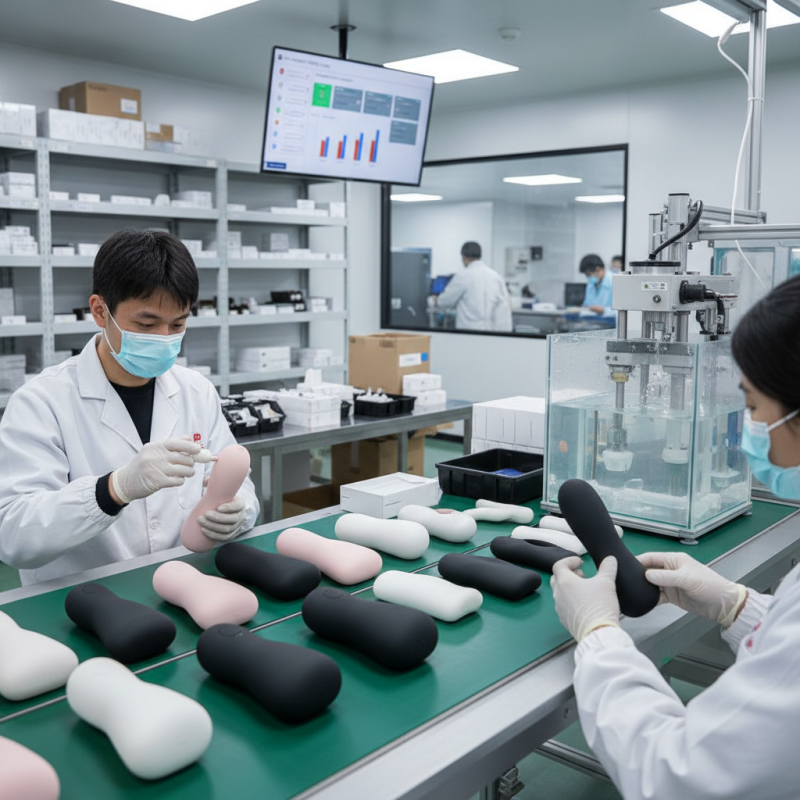
Electric masturbators are powered devices designed to provide rhythmic, adjustable stimulation through motors, sleeves, or air-pressure systems. Common functions include speed control, pulse patterns, warming, and app-free manual operation. Grand View Research estimated the global sex toys market at about USD 35 billion in 2023, with continued growth expected through 2030. That growth increases pressure on manufacturers to prove material safety and performance, rather than relying on attractive packaging.
Materials directly affect comfort, cleaning, and service life. Platinum-cured silicone offers a smooth, non-porous surface and stable flexibility. ABS is often used for rigid housings because it resists impact and supports precise molding. TPE feels softer but may absorb residue more easily, so users need careful cleaning and drying. “Medical-grade” should not stand alone as a claim. Suppliers should provide test documents and migration data.
IPX ratings describe water protection under IEC 60529. IPX4 resists splashing, while IPX5 handles water jets. IPX7 permits temporary immersion, typically up to one meter for 30 minutes under test conditions. IPX8 depends on the manufacturer’s stated depth and duration. A higher rating does not automatically mean safer charging. Port seals, battery insulation, and charger separation still require inspection. In practice, mistakes happen when teams treat laboratory ratings as unlimited waterproofing. That assumption needs correction. Industry testing should include repeated charging, sleeve removal, cleaning cycles, and motor heat checks before shipment.
| Category | Dimension | Reliable Data and Specification | Manufacturer and Buyer Relevance |
|---|---|---|---|
| Product Definition | Electric masturbator | A reusable intimate device powered by a battery or external power source. It applies mechanical stimulation through a sleeve, opening, chamber, or other body-contact surface. | The product definition should clearly identify the intended use, operating method, power source, and body-contact components. |
| Product Structure | Main components | Typical components include an outer housing, removable or fixed insert, motor or air-pulse module, rechargeable battery, control panel, charging interface, seals, and electronic control board. | A modular structure can simplify cleaning, maintenance, assembly, and replacement of consumable inserts. |
| Function | Vibration | Uses an electric motor to generate oscillating movement. Products may provide several vibration patterns and adjustable intensity levels. | The control range should be verified through functional testing rather than described only by the number of advertised modes. |
| Function | Reciprocating movement | Uses a motor-driven mechanism to create repeated linear or rotational movement. The actual stroke length, speed, noise, and load performance depend on the mechanism and control system. | Manufacturers should test movement consistency, operating noise, heat generation, and durability during repeated cycles. |
| Function | Air-pulse stimulation | Uses controlled changes in air pressure or airflow to create pulsing sensations without requiring direct mechanical reciprocation. | Air channels, valves, pumps, and seals require leakage testing and cleaning instructions appropriate to the design. |
| Function | Heating function | An integrated heating element may warm the contact surface. Temperature control should include a sensor, programmed limit, and protection against overheating. | Temperature rise, surface temperature, cut-off behavior, and charging safety should be tested under normal and abnormal operating conditions. |
| Function | User controls | Common controls include power, intensity adjustment, mode selection, heating control, travel control, and battery-status indicators. Some models also use wired or wireless controls. | Buttons should be easy to operate, resistant to accidental activation, and clearly described in the user instructions. |
| Material | Platinum-cured silicone | A flexible, non-porous elastomer commonly selected for removable sleeves and skin-contact surfaces. It should be free from visible defects, excessive odor, and unsafe surface contamination. | Material documentation, hardness consistency, tear resistance, dimensional stability, and compatibility with the cleaning method should be confirmed. |
| Material | TPE or TPU | Thermoplastic elastomers can provide a soft and flexible feel. Depending on formulation and surface finish, some grades may retain more residue than smooth non-porous silicone. | The exact grade, additives, odor, migration performance, and cleaning instructions should be specified instead of using only the general term “soft material.” |
| Material | ABS or PC housing | ABS and polycarbonate are common rigid plastics for external housings. They provide structural support but do not automatically make a product waterproof. | Housing design should be evaluated for impact resistance, dimensional accuracy, chemical compatibility, and protection of internal electronics. |
| Material | Metal parts | Stainless steel or plated metal may be used for shafts, weights, fasteners, or decorative parts. Metal selection should consider corrosion resistance and contact safety. | Metal surfaces should be smooth, securely fixed, free of sharp edges, and protected from corrosion caused by moisture or cleaning agents. |
| Hygiene | Cleaning design | Removable inserts, smooth surfaces, minimal crevices, drainable cavities, and clearly defined cleaning procedures can improve hygiene. Cleaning instructions must match the product’s water-resistance level. | A product should not be described as washable unless the complete assembled product or the relevant removable component has been tested for that use. |
| Ingress Protection | IPX0 | No stated protection against water ingress under the IP Code system defined by IEC 60529. | Keep the powered product away from water and use only the cleaning method stated in the instructions. |
| Ingress Protection | IPX1–IPX3 | IPX1 protects against vertically dripping water. IPX2 protects against vertically dripping water when the enclosure is tilted up to 15 degrees. IPX3 protects against water spraying up to 60 degrees from vertical. | These ratings do not mean that the product is suitable for immersion, shower use, or rinsing under a tap. |
| Ingress Protection | IPX4 | Protection against water splashing from any direction when tested according to the applicable IP Code conditions. | It may support limited splash exposure, but the manufacturer should still define whether cleaning, shower use, or full-body rinsing is permitted. |
| Ingress Protection | IPX5–IPX6 | IPX5 protects against water jets. IPX6 protects against powerful water jets. These ratings address water jets, not automatic protection against immersion. | A product with IPX5 or IPX6 should not be marketed as submersible unless it also has an appropriate immersion rating and supporting test evidence. |
| Ingress Protection | IPX7 | Protection against temporary immersion in water under the specified test conditions, commonly up to 1 meter for 30 minutes in IEC 60529 testing. | The rating applies to the tested configuration. Charging ports, covers, seals, and removable parts must be correctly closed or installed before exposure. |
| Ingress Protection | IPX8 | Protection against continuous immersion under conditions agreed between the manufacturer and the relevant testing organization. The depth and duration are not universally fixed by the IPX8 designation alone. | Marketing materials should state the tested depth, duration, configuration, and limitations instead of presenting IPX8 as a single universal performance level. |
| Ingress Protection | IPX9 | Protection against high-pressure and high-temperature water jets under the relevant test conditions. IPX9 is not the same as a general immersion rating. | The exact test method and product configuration should be documented before using this rating in technical or promotional materials. |
| Power System | Rechargeable battery | Lithium-ion or lithium-polymer cells are commonly used because of their energy density. The design should include suitable charging control, overcharge protection, short-circuit protection, and thermal protection. | Battery capacity, charging time, operating time, cell supplier documentation, and protection behavior should be validated for every production revision. |
| Power System | Charging interface | Charging may use a magnetic connector, dedicated cable, or USB-based connection. The charging interface should be designed to prevent unsafe use with moisture present. | Clear instructions should state whether the device must be completely dry before charging and whether the charging cable is water-resistant. |
| Safety and Quality | Surface and assembly inspection | Inspection should cover burrs, sharp edges, flash, cracks, loose parts, uneven seams, material contamination, abnormal odor, and incomplete bonding or sealing. | A documented inspection standard helps maintain consistent quality across production batches and private-label orders. |
| Safety and Quality | Functional reliability | Typical validation includes repeated operating cycles, button-life testing, charging-cycle testing, motor performance, noise measurement, temperature monitoring, and water-ingress testing when applicable. | Test conditions, sample quantities, acceptance criteria, and test records should be defined before mass production. |
| Documentation | Technical file | A useful technical file may include material specifications, component lists, battery information, drawings, risk assessment, user instructions, inspection records, and applicable test reports. | Complete documentation supports product traceability, regulatory review, after-sales service, and accurate technical marketing. |
| Packaging | Product information | Packaging and instructions should provide operating steps, cleaning and drying requirements, charging warnings, storage guidance, disposal information, and the verified IP rating if applicable. | Claims such as “waterproof,” “body-safe,” or “quiet” should be supported by defined test methods and should not exceed the verified product performance. |
: Request the ISO 9001 certificate number, expiry date, issuing body, and certified production address. Confirm that its scope includes design, assembly, and quality control. A certificate shows management systems. It does not guarantee perfect products.
Review worker training, incoming-material checks, battery testing, waterproof testing, and final inspection records. Ask for nonconformities and corrective actions. Traceable batch records matter more than spotless floors. A staged video tour remains possible.
Request monthly output, active production lines, seasonal utilization, and recent shipment records. Confidential information can be removed. Compare these figures with audit findings and production schedules. Claims need proof.
A pilot order may require 300–500 units. Customized molds often require 1,000 units or more. These figures are working benchmarks, not fixed rules. Confirm sample fees, tooling ownership, packaging quantities, and replacement rates.
Request documents covering IPX7 testing, restricted substances, chemical safety, electromagnetic emissions, and lithium-battery transport. Check certificate numbers independently. Review laboratory scope and test dates. The battery model must match the shipped battery.
No. IPX7 usually covers temporary immersion up to one metre for 30 minutes. It does not confirm dust protection. Ask for sealing records and production inspections. Repeated charging cycles may expose weaknesses.
Ask whether the factory uses ISO 2859-1 sampling methods. AQL 1.5 can apply to critical defects, while AQL 2.5 can apply to major defects. Request sample sizes, defect counts, photos, and corrective actions. An AQL promise without records is weak evidence.
Stock-adapted projects may take 20–35 days. New molds may add 15–30 days. Separate tooling, pilot production, repeat orders, packaging approval, and testing delays. Warranty terms should identify covered parts, return procedures, and response targets. Batteries may be excluded.
Compare the full landed estimate, including molds, packaging, testing, firmware, artwork, and minimum order quantities. Ask who owns the tooling. Request replacement-part pricing before signing. A lower unit price may hide revision costs. Leave time for a second sample.
This guide explains how to evaluate an Electric Masturbator manufacturer from product design to export readiness. It covers essential functions, body-safe materials, ergonomic construction, and IPX water-resistance ratings, helping buyers define suitable product specifications. It also places China’s role in the 2023 sexual wellness market into context, with attention to export capabilities, production experience, and supply-chain reliability.
A practical supplier assessment should include ISO 9001 certification, factory audits, production capacity, and transparent MOQ information. Buyers should also verify compliance with IEC 60529 IPX7 testing where applicable, RoHS, REACH, FCC, and UN38.3 requirements for products containing batteries. Finally, the guide compares suppliers through AQL 1.5/2.5 quality standards, realistic lead times, warranty policies, OEM development costs, packaging options, and after-sales support. These checkpoints help businesses select a reliable, compliant, and cost-effective manufacturing partner.

 COMFLY